


Sensory bins with tweezers
Author: Anne Vos
Teacher and mother
We love sensory bins! I love coming up with and putting them together, and Lotte loves playing with them, so it's a win-win situation.
A sensory bin, through its contents, encourages a child to use one or more of their senses (sight, hearing, touch, smell, taste). It is also a very suitable tool for practicing fine motor skills, and you can incorporate all sorts of other learning experiences, such as counting, sorting, letter recognition, rhyming. Moreover, it's a great way to stimulate imaginative play. And all of this in a very engaging, fun way that also costs very little!
Sensory bins are not specifically suitable for a particular group of children; all children can enjoy them and benefit from them. But not all children necessarily benefit in the same way. To give an idea of how you can use such a bin, I will provide some examples.
- Lotte, for example, is a real thinker and can sometimes worry a lot, so for her, rummaging in such a bin with rice and scooping that rice from one small container to another is a good way to let go of worrying for a while and to focus on feeling and experiencing. Especially when she is tired, it really helps her to calm down. But she also has a very rich imagination and loves to play entire role-playing games in and around the bin.
- If you have a child with a fine motor skill impairment, the bin can be a fun way to practice those fine motor skills. You can do this, for example, by filling the bin with items that encourage picking up small objects. If you don't want it to be too obvious that this is the intention, for example, because your child finds practicing frustrating, you can subtly incorporate that practice by choosing a favorite theme. For instance, for a pirate fan, you could hide coins for treasure among blue rice and let him or her search for the treasure. Or hide small items in clay or kinetic sand and let them dig them out with their hands.
- For a child with an autistic impairment, it can be a way to calm down by stimulating a specific sense, possibly linked to a topic that currently intrigues them. Letting sand slip through the fingers is often a favorite soothing activity, but in that case, rice will probably also be well-received. Take rice in cheerful colors and it becomes extra interesting. Or fill a bin with pompoms of different sizes in their favorite color. If there's a strong interest in spinning and rolling objects, fill the bin with balls, tops, screws, corks, bottle caps, and whatever else you can think of that spins or rolls.
- If a child has difficulties with math or reading, you can playfully incorporate practice games into the bin by challenging them to count certain objects the child likes (how many small cars/green dinosaurs/princesses in a pink dress/chickens on the farm) or by hiding letters or putting objects whose names rhyme into the bin.
- For a child with speech problems, you can also put objects in the bin that encourage practice. For example, if a certain sound is difficult to pronounce, hide all sorts of items among paper shreds whose names begin with or contain that sound and go treasure hunting. When you find the object, you both enthusiastically name what you have found.
There are countless possibilities, as long as you connect with your child's interests. To discover those interests, you can observe your child while they play to see if there are recurring themes, listen to your child to find out what they often talk about, or you can simply ask your child what they find interesting at that moment. And of course, you can also connect to the time of year (summer, autumn, winter, spring, Saint Nicholas, Christmas, Easter, birthday, etc.). And if your child has a certain impairment or learning disability, discuss with their therapist or teacher that you want to make a sensory bin and ask if he or she has any tips on what you could put in the bin.
I often make the bins as a surprise for Lotte when she comes home from school. She loves to rummage through the rice or beans with her hands, scoop and pour, but also to invent whole stories with her Playmobil or Frozen dolls in a play setting I've created in the bin.
It also happens that she suddenly decides she wants a princess bin (pink rice with glitter, pink glass beads, Playmobil princesses) or an underwater bin (blue rice, shells, Playmobil fish and divers) to play with, and she dives into the cupboard herself to collect the right color rice and other necessities. My task then is limited to grabbing an empty storage box.
What's also fun is to make the bin together. First, you come up with a theme, alone or together, and then you let your child search for fun items to put in it.
And whether I made the bin or she put it together herself, it's always good for at least an hour of nice, quiet play and relaxation!
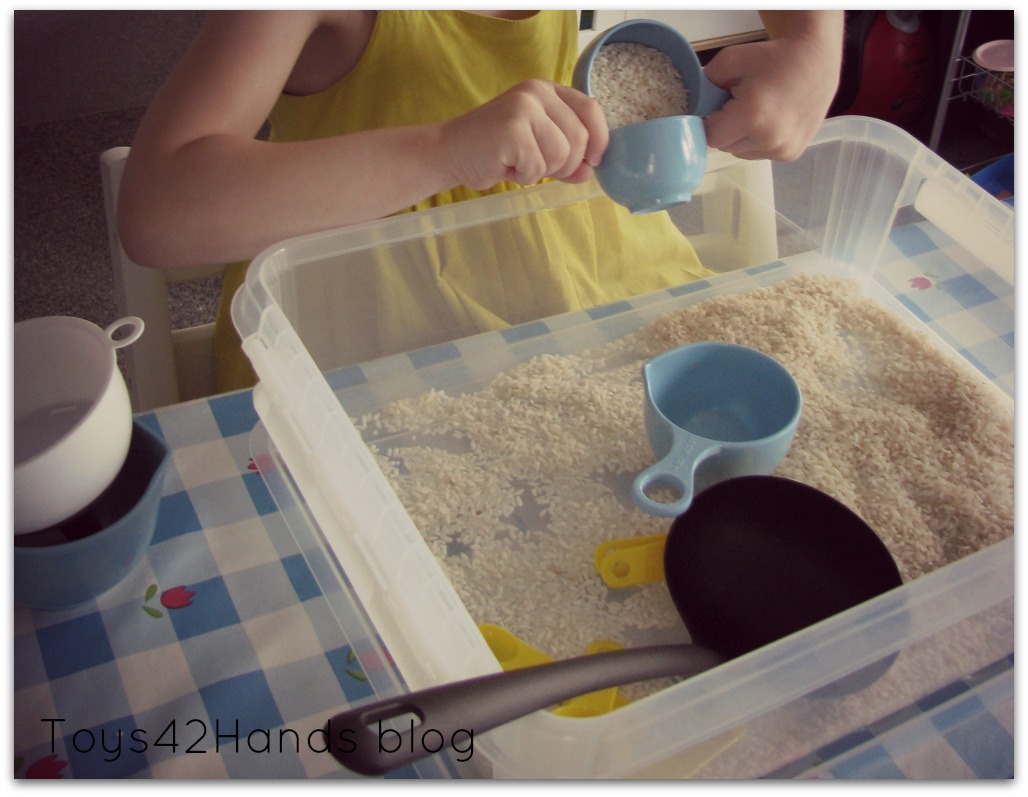
Measuring and weighing (white rice, measuring scoops, ladle, funnel)
Princess Garden (pink dyed rice with glitter, glass beads, sequins, Playmobil princesses and animals, aquarium bridge)
How to make a sensory bin?
- To start, it's helpful to choose a theme as a starting point. As I mentioned, the most fun sensory bins have a theme that aligns with something your child is very engaged with or interested in. This can be anything: the color red (different red objects), winter, princesses, counting, the first letter of their name (letter magnets, objects starting with that letter), fish, farm.
- Then, of course, you need a bin. I usually use the storage boxes with (clip) lids from Hema because they are transparent, can take a beating, and you can easily close them after playing and set them aside for another time. These bins come in all sizes, but I prefer 40x30x12 cm or 50x39x18 cm. For multiple children, a bed storage box is a good alternative, but then you'll naturally need more material to fill it. If you have a sand and water table, you can also use that. Or choose a bin that fits the theme, for example, a wooden bowl or tray for an autumn theme, or a Christmas tree-shaped baking pan for a Christmas bin.
- Consider beforehand where your child will be allowed to play with the bin and how tolerant you are of spills. Things can sometimes go over the edge in the heat of play. I usually place the bin on a table. If they're playing with water, I put a large towel underneath, otherwise, after playing, I grab the handheld vacuum or regular vacuum. If you don't have time or inclination for that, you could also place the bin on the floor with a sheet or tablecloth underneath; then you only need to shake it out after playing. And in the summer, of course, you can go outside!
- Then, of course, that bin needs to be filled with something. There are many possibilities, depending on your theme and your child's age. For small children, you naturally need to consider carefully whether they might put things in their mouths and if that would be safe! For us, the following filling materials are favorites as a base: uncooked white rice or pasta, uncooked colored rice (rice, a good splash of poster paint and possibly some glitter, stir and let dry on a flat tray) or pasta, water, paper shreds, kinetic sand, dried corn/beans/legumes, serpentine, cotton wool. Rice, pasta, and beans/legumes/corn can be stored for a very long time in zip-lock bags or food storage containers, so you can reuse them repeatedly.
- To this base, you can add all sorts of extras that fit your theme, such as pompoms, cut-up straws, beads and sequins, buttons, pipe cleaners/chenille stems, (colored or natural) ice cream or match sticks, water beads (in water), coarse or fine glitter, leaves/twigs/pine cones, etc., glass beads, ribbons, shells, stones, and so on.
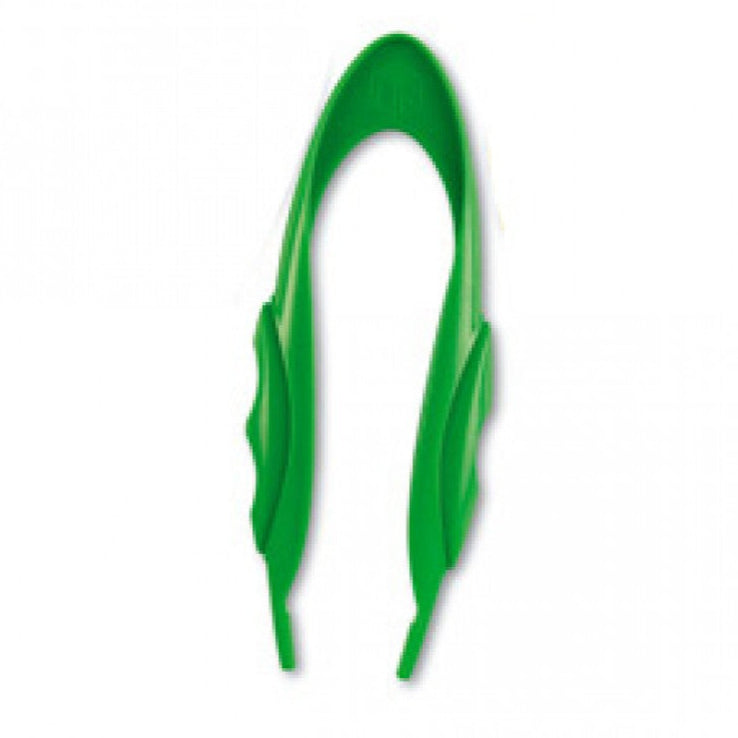
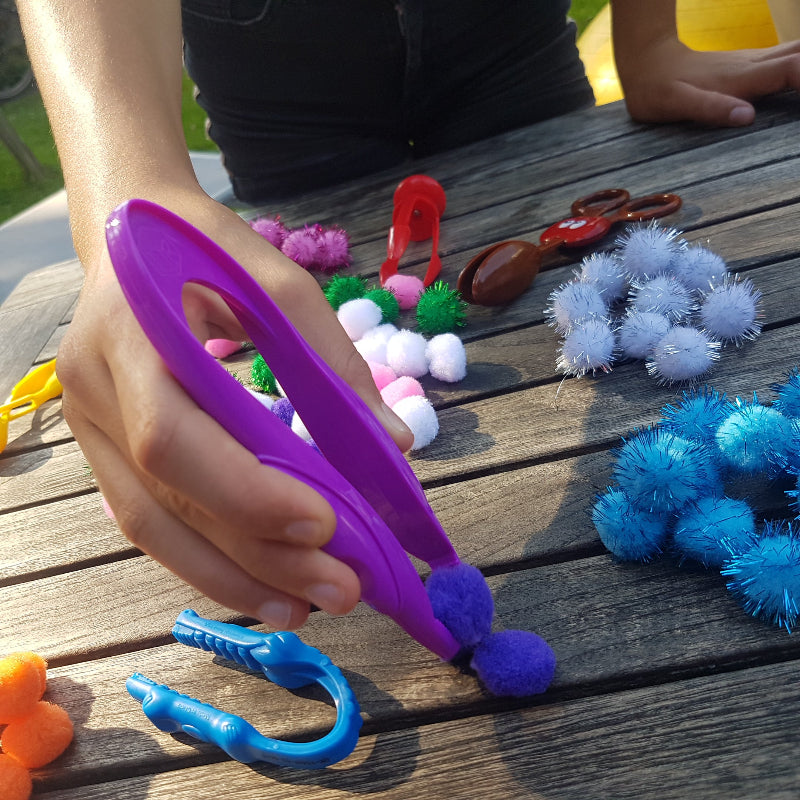
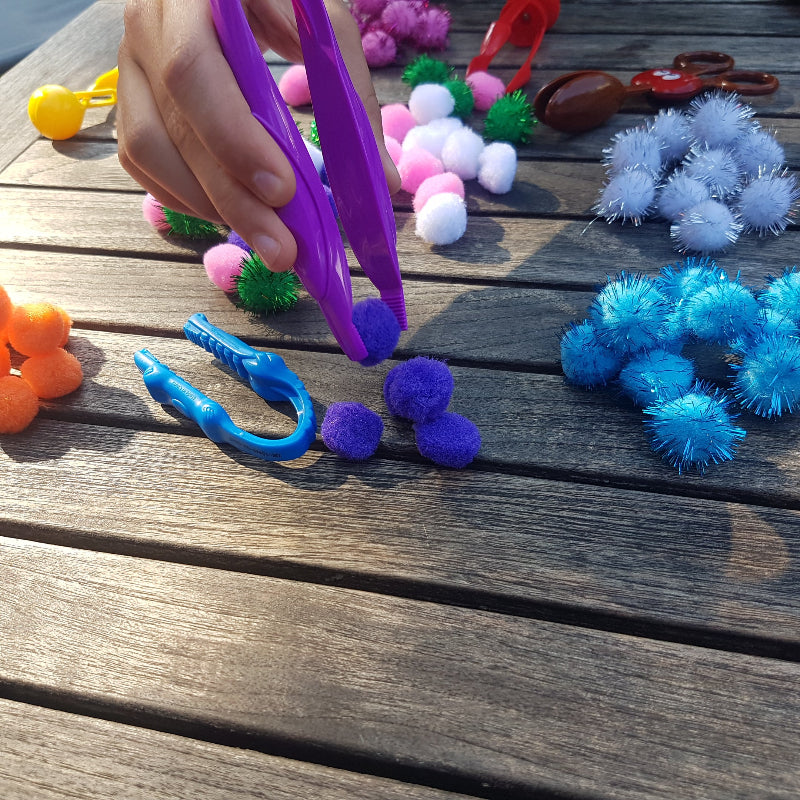
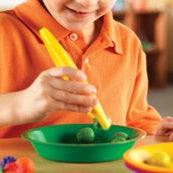
- Finally, you add play materials so the fun can begin. This can be anything, but you're always good with scoops, spoons, small containers, funnels, plastic tweezers (e.g., jumbo tweezers from Toys42Hands), toilet paper and kitchen rolls (whole or cut lengthwise in half as a kind of slide), measuring scoops and cups, a tea strainer, an egg carton/muffin tin/serving dish with compartments, and of course small toys like Playmobil (animals, figures, furniture, etc.), cars, plastic animals or figures, or whatever your child likes. A big favorite of Lotte's is to let her Barbies swim in a larger and deeper storage box filled with (lukewarm) water, shells, toy fish, and Playmobil figures. In short: you can imagine anything and it can go in!
Winter (white rice, glass beads, cut-up straws, sequins, pompoms, measuring scoops, tea strainer, jumbo tweezers, divided dish)
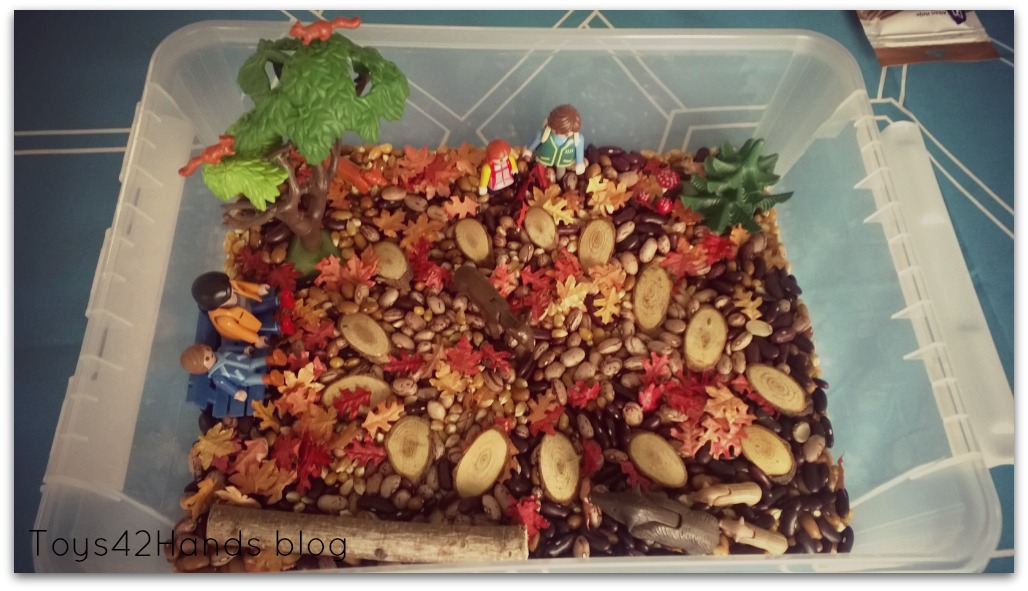
Autumn Walk (different types of dried beans and corn, wood pieces, small fabric autumn leaves, Playmobil)
Are you enthusiastic but not sure where to start? The photos in this post show some bins I made for Lotte last year. And if you search for 'sensory bins/tubs' on Google or Pinterest, you'll find many more examples.
Deep Sea Diving (deco sand, shells, stones, Playmobil)
Birthday (serpentine, wrapping paper, gift ribbons, bows, stickers, scissors, tape, boxes for wrapping)
Oh, one last tip: I always make an agreement with Lotte that I understand some things might go over the edge of the bin during play, but she has to clean up if I see her deliberately scattering the contents across the room, just to scatter. The latter has never been necessary, by the way, because she finds the bins too much fun to throw things around with... ;-)



Leave a comment